
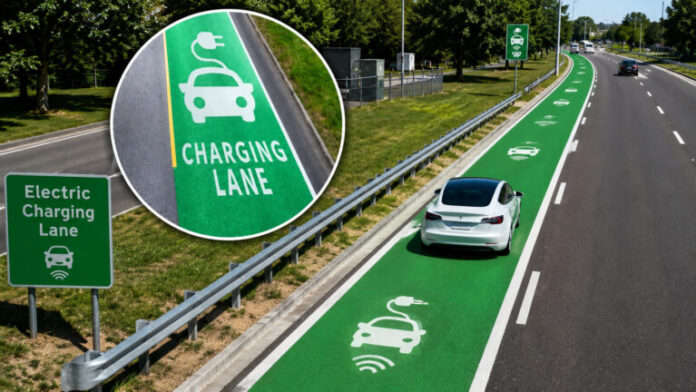


.And Could Change The Future Of Wireless Charging —
While many third world countries are still battling to fix their asphalt roads, United States of America (USA) has taken easy ride to another level with the road that charges electric vehicles through the ground.
This advanced technology is already operational in the US and this could change the future of wireless vehicle charging.
Eyeonthenews.news gathered from roleoegas.com that a relevant innovation for electric mobility was inaugurated in Detroit, United States, recently, drawing attention for the use of a technology still uncommon in urban roads.
The so-called electric highway uses wireless charging through magnetic induction, with coils installed below the pavement.
The system, developed by the company Electreon, allows adapted electric vehicles to receive energy while passing over the electrified section.
The proposal seeks to test an alternative to traditional charging stations, as the supply can occur in motion, at a slow pace, or with the vehicle stopped on the track.
The structure works through inductive platforms placed below the asphalt and connected to a system capable of transferring electricity without cables.
The vehicle needs to be equipped with a compatible receiver to capture the energy emitted by the underground coils.
This detail limits the use of the technology, as common electric cars do not automatically receive charge when driving on the lane.
Nevertheless, the test demonstrates how urban roads can become an active part of the electric charging infrastructure.
It was further gathered that the project was implemented in a section of approximately 400 meters in Detroit, a city historically linked to the North American automotive industry.
The electrified lane was created to evaluate the performance of dynamic charging under real usage conditions.
According to the released data, the system delivered 16 kW of power to a test vehicle traveling at 15 km/h.
Meanwhile, the performance is still below many public fast chargers, which can reach 50 kW, but the initial goal is to validate the technology.