


World’s most followed reggae artist the late Bob Marley is the man in our Down Memory Lane story for this week.
Read how a racist judge punished him for his colour and appearance, not his actual offense in the story below;
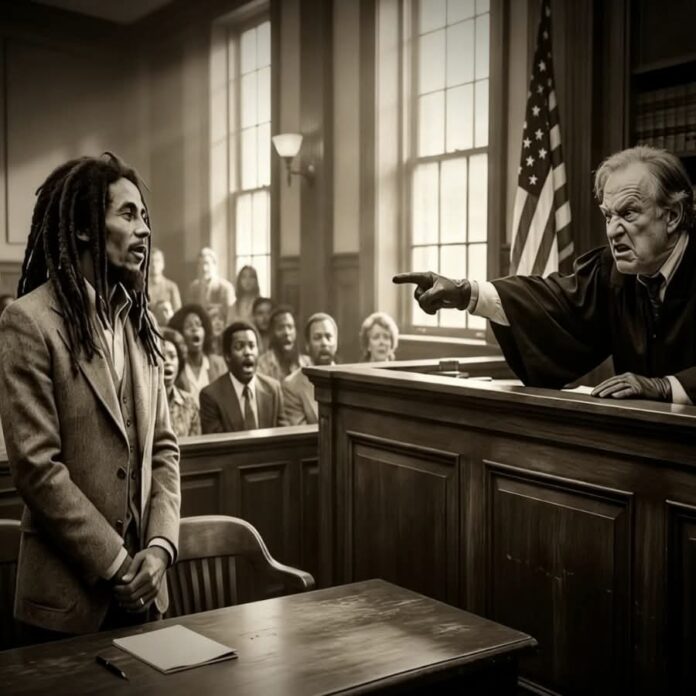
A racist judge gave Bob Marley $500 Fine instead of $50 during the case, but Bob’s response to the charge broke the biased judge completely.
Meanwhile, the gavvel came down like a thunderclap, echoing through the packed Manhattan criminal court as Judge Samuel Morrison delivered his verdict with barely concealed satisfaction.
Mr. Marley, for the violation of running a red light, I sentence you to a $500 fine and 40 hours of community service.
The courtroom gasped after hearing the verdict.
Everyone present knew that the standard fine for this minor traffic violation was $50 with no community service required.
Bob Marley sat calmly in the defendant’s chair, his dreadlocks and casual attire marking him as different from the suited lawyers and court officials surrounding him.
It was October 8th, 1979, and what should have been a routine traffic court appearance had become a blatant display of judicial racism that would shock everyone present and ultimately transform the very judge who had delivered the discriminatory sentence.
Judge Samuel Morrison had presided over traffic court Division 7 for 12 years, building a reputation as a stern jurist who believed in using his authority to teach lawbreakers proper respect for societal rules.
At 62 years old, Morrison viewed the social changes of the 1970s with deep suspicion, seeing defendants with long hair or casual clothes as people who needed to be reminded of their place.
Bob Marley had received a traffic citation 3 weeks earlier for allegedly running a red light at 412nd Street and Broadway.
He arrived at court that morning dressed respectfully in clean jeans, a button-down shirt, and a sports jacket, expecting a brief hearing where he would explain that the light was yellow when he entered the intersection.
But from the moment Bob entered the courtroom, Judge Morrison’s attention was fixed on him with obvious disapproval. Morrison had recognized Bob Marley from media coverage, and everything he had read reinforced his belief that this reggae musician was corrupting American youth with dangerous ideas about drugs, rebellion, and racial mixing.
The People versus Robert Nesta Marley, the court clerk announced. Morrison looked down at Bob with undisguised contempt. Mr. Marley, you’re accused of running a red light on September 17th, 1979. How do you plead?
“Not guilty, your honor. The light was yellow when I entered the intersection”. Morrison’s expression hardened.
“Perhaps you were under the influence of illegal substances and your perception was impaired. That would be consistent with your public advocacy for drug use. Bob’s attorney stood up. Your honor, my client’s personal beliefs are not relevant to this traffic case. I’ll determine what’s relevant in my courtroom”. Morrison snapped.
I find it very relevant that we have a defendant who publicly promotes illegal drug use and anti-establishment attitudes”.
Bob remained calm. Your honor, I’ve never publicly promoted illegal drug use. I’ve spoken about traditional spiritual practices, but that has nothing to do with whether I ran a red light.
Morrison leaned forward menacingly. Your so-called spiritual practices involve marijuana, which is illegal. Your music encourages young people to break the law and reject authority. You represent exactly the kind of foreign influence that’s undermining American values. Your honor, Bob’s attorney interjected. I must object to this line of questioning.
This is a traffic court, not a hearing on my client’s musical career or personal beliefs. Objection overruled,” Morrison said with satisfaction. “In my courtroom, I consider the character of the defendant when determining appropriate penalties. And Mr. Marley’s character, based on his public statements and influence, suggests someone who has little respect for American laws and institutions.
Bob stood up slowly, maintaining his dignity. “Your honor, may I speak for myself?” You may, Morrison said, expecting Bob to incriminate himself further.
“Your honor, I came to America because I believe in freedom and opportunity. My music speaks about love, unity, and spiritual awakening. I’ve never encouraged anyone to break laws or harm others. I pay my taxes.
“I respect this country’s institutions. And I’m here today showing respect for this court”.
Bob looked directly at Morrison. “But I can see that you’ve already decided I’m guilty, not because of evidence about running a red light, but because of how I look and what you think I represent. That’s not justice, your honor”.
“That’s prejudice”. The courtroom fell silent. Morrison’s face flushed with anger. “Mr. Marley, you are in contempt of this court for questioning my integrity”.
“I’m not questioning your integrity”, Bob replied calmly. “I’m questioning whether you can separate your personal feelings about me from the facts of this case”, Bob Marley said in defence of himself.
Morrison had never been challenged so directly. His prejudice was being exposed in front of a packed courtroom, and he felt his authority slipping.
“I find you guilty of the traffic violation,” Morrison announced angrily. Given your disrespectful attitude toward this court and your public influence in promoting lawlessness, I sentence you to the maximum fine of $500 plus 40 hours of community service.
The courtroom erupted. Bob’s attorney immediately stood up. “Your honor, this sentence is completely disproportionate. The standard fine is $50 with no community service”.
“Request denied”, Morrison said with finality. Perhaps Mr. Marley will think twice before promoting drug use and disrespect for authority to American youth”.
Bob looked up at Morrison with sadness rather than anger. “Your honor, I hope someday you’ll understand that judging people by their appearance instead of their actions doesn’t serve justice. It serves prejudice”.
Morrison banged his gavvel! Court dismissed. Next case. As Bob left the courthouse, word of Morrison’s discriminatory sentence spread quickly through New York’s legal and entertainment communities.
That evening, Morrison went home feeling satisfied about delivering an important message. He lived alone since his wife’s death, his only regular companion being his 18-year-old grandson, Michael, who was staying with him while attending Columbia University. Michael was a huge Bob Marley fan who had attended several concerts.
When he saw his grandfather watching news coverage of the case, he was horrified.
Grandpa, you sentenced Bob Marley to $500 in community service for running a red light”.
“I sentenced a law-breaking drug advocate to appropriate penalties”, Morrison replied defensively. “Grandpa Bob Marley isn’t a drug advocate”.
“He’s a spiritual teacher whose music has helped millions of people find peace. He’s helped me deal with losing my parents and finding direction in my life”.
Morrison looked at his grandson with growing concern. “Michael, you don’t listen to that music, do you”?
“I believe in his ideas about love and unity and treating people with respect regardless of their race,” Michael said firmly.
“Ideas that you apparently don’t share.” Morrison felt like he had been punched. His beloved grandson was telling him that his prejudices were wrong and harmful.
“What I understand is that you just used your position as a judge to punish someone because of his race and appearance, not because of what he actually did,” Michael interrupted.
—Source: Facebook stories.